
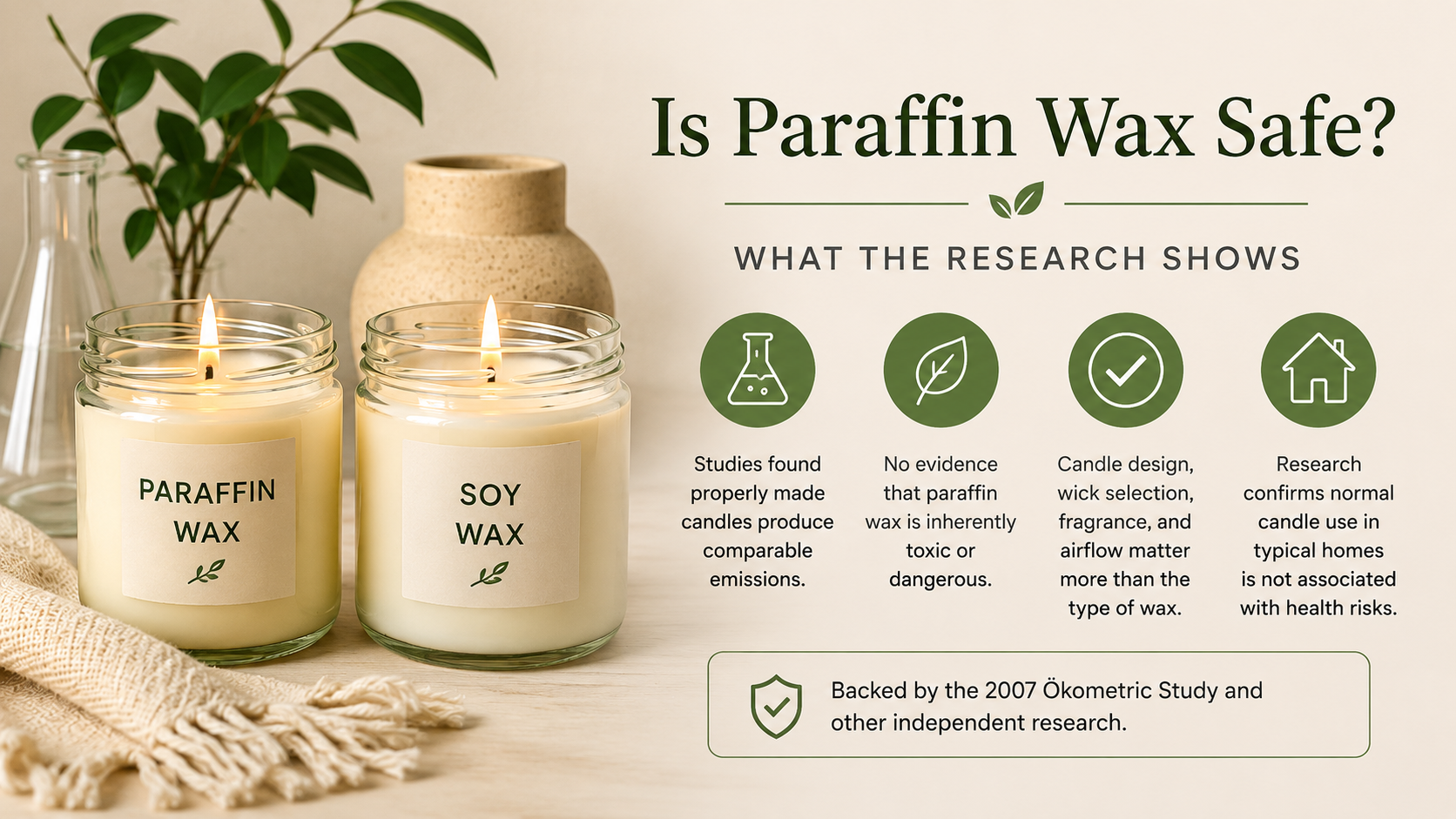
Paraffin wax has been used in candles for more than a century, yet it is frequently described online as “toxic,” “dirty,” or unsafe to burn. Soy, coconut, palm, beeswax, and other plant-based waxes are often promoted as cleaner and healthier alternatives.
However, the scientific evidence does not support the claim that properly made paraffin candles are inherently dangerous or that plant-based candles are automatically safer.
Controlled emissions studies have generally found that properly manufactured paraffin candles produce emissions comparable to soy and other common candle waxes. The construction of the candle, wick selection, fragrance formulation, airflow, and burning conditions can have a greater effect on emissions than whether the wax originated from petroleum or a plant.
Detecting a Chemical Does Not Automatically Mean It Is Dangerous
Every burning candle produces combustion byproducts. This is true for paraffin, soy, coconut, palm, stearin, beeswax, and other combustible waxes.
Depending on the candle and the conditions under which it is burned, those byproducts may include carbon dioxide, very small particles, and trace amounts of volatile organic compounds, commonly called VOCs.
Finding a chemical does not automatically mean that a product creates a dangerous exposure.
There is an important difference between a hazard and a risk.
- A hazard is something that can cause harm at a sufficiently high dose.
- Risk considers how much of the substance is present, how long someone is exposed, and whether the exposure reaches a harmful level.
Benzene, formaldehyde, and other chemicals can be hazardous at high enough concentrations. However, detecting a trace amount does not prove that a person burning a candle in an ordinary room is receiving a harmful dose.
To understand the actual risk, researchers must measure or estimate the concentration in the room and compare it with established indoor-air guidelines.
What the 2007 Ökometric Wax and Emissions Study Found
One of the most important studies comparing different candle waxes was the 2007 Ökometric Wax and Emissions Study.
The study was conducted by Ökometric GmbH at the Bayreuth Institute of Environmental Research in Germany. Researchers tested reference candles made from five major candle fuels:
- Paraffin wax
- Soy wax
- Palm wax
- Stearin
- Beeswax
The candles were manufactured with properly selected wicks so that each wax could burn efficiently and at a comparable fuel-consumption rate.
Researchers examined emissions from more than 300 chemicals or chemical groups, including volatile organic compounds, aldehydes, polycyclic aromatic hydrocarbons, dioxins, and furans.
They then estimated the indoor-air concentration that could result from burning one candle for four hours in an unventilated room measuring 50 cubic meters. This was a conservative scenario because most homes have at least some natural or mechanical ventilation.
The estimated concentrations were compared with indoor-air standards and guidelines from the United States, Europe, and Germany.
The study found that the major candle waxes produced broadly comparable combustion byproducts when the candles were properly manufactured and burned normally. No wax demonstrated a consistent overall health advantage.
You can read the published summary of the study here: Summary of the 2007 Ökometric Wax and Emissions Study
Emissions Were Far Below the Selected Indoor-Air Limits
According to the Ökometric study summary, the total VOC concentrations from the reference candles averaged less than 2% of the applicable indoor-air standard used for the comparison.
Benzene was not detected in any of the normally burning reference candles.
The calculated formaldehyde concentration was below 1% of the selected indoor-air standard. Acetaldehyde and propionaldehyde were each below 2% of the selected standards.
These results are important because they place the detected emissions into context. The researchers did not simply report that a substance could be found. They estimated how much of it might be present in the air of a room and compared that amount with recognized indoor-air limits.
Poor Wick Selection Increased Emissions in Both Paraffin and Soy Candles
The Ökometric study also tested deliberately over-wicked paraffin and soy candles.
An over-wicked candle has a wick that is too large for the candle. This can create an oversized flame, excessive fuel consumption, smoke, and visible soot.
Both the over-wicked paraffin candle and the over-wicked soy candle produced more emissions than the properly burning reference candles.
This demonstrated that poor candle construction can increase emissions regardless of whether the candle is made with petroleum-based wax or vegetable-based wax.
Even in the deliberately high-soot tests, the measured emissions remained below the air-quality benchmarks selected for the study.
This does not mean that soot should be ignored. A candle that is producing persistent smoke or visible soot is not burning properly and should be extinguished.
It does mean that sooting is not a problem unique to paraffin wax. A soy, coconut, palm, beeswax, or blended-wax candle can also soot when it is improperly wicked, exposed to drafts, overloaded with fragrance, or allowed to burn with an excessively long wick.
A 2021 Peer-Reviewed Study Reached a Similar Conclusion
A later peer-reviewed study published in the journal Environment International examined emissions from 24 combinations of candle waxes and fragrances.
Researchers tested four wax types:
- Paraffin
- Soy
- Palm
- Stearin
The study included five fragrance formulations as well as unscented control candles.
Researchers measured several types of emissions, including formaldehyde, benzene, VOCs, carbon monoxide, nitrogen oxides, polycyclic aromatic hydrocarbons, PM2.5, and ultrafine particles.
The researchers found that the four unscented waxes behaved very similarly. No individual wax had a consistently better overall emissions profile than the others.
The study also found that fragrance formulation could have a greater effect on emissions than the type of wax. Unscented candles generally produced fewer combustion byproducts, while certain fragrance formulations produced higher levels of particular VOCs or particles.
Most of the estimated household concentrations were below the applicable health-based guidance values. The researchers also identified some exceptions involving substances such as nitrogen dioxide, acrolein, and benzo[a]pyrene in particular test conditions.
The complete study is available here: Measurement and Evaluation of Gaseous and Particulate Emissions from Burning Scented and Unscented Candles
The important finding was not that candles produce no emissions. The finding was that paraffin did not consistently perform worse than soy, palm, or stearin when comparable candles were tested.
A 2014 Health-Risk Evaluation Also Supported Normal Candle Use
A 2014 study evaluated the potential health risks associated with emissions from scented candles.
Researchers measured volatile organic compounds, semi-volatile compounds, and particulate matter. They then used both conservative and more realistic exposure scenarios to estimate the amount consumers might inhale during ordinary candle use.
The study concluded that scented candles used under normal conditions did not present known health risks to consumers.
You can view the study information through the National Library of Medicine: Human Health Risk Evaluation of Selected VOC, SVOC and Particulate Emissions from Scented Candles
This study did not claim that burning candles creates perfectly clean air. Instead, it evaluated whether the estimated exposure was high enough to create a known health risk.
Danish Government Testing Produced Surprising Results
A 2018 project published by the Danish Environmental Protection Agency tested particle and chemical emissions from different candles.
Among the five candle types examined, the paraffin pillar candle produced the lowest ultrafine-particle number concentration in that particular series of tests.
The paraffin candle also had the lowest measured percentage of black carbon compared with the total particle mass recorded by one of the testing instruments. Black carbon is commonly used as an indicator of soot.
This does not prove that every paraffin candle will produce less soot than every vegetable-wax candle. Candle performance depends on the complete candle design.
However, it does show why broad claims such as “paraffin always produces more soot” or “plant wax always burns cleaner” are not scientifically reliable.
The Danish researchers found that emissions were affected by factors such as fuel-consumption rate, wick selection, wick treatment, and burning conditions.
The complete Danish Environmental Protection Agency report can be read here: Survey and Risk Assessment of Particle and Heavy Metal Emissions from Candles
Long-Term Research Has Not Shown a Clear Increase in Hospital Visits
A Danish cohort study published in 2022 followed participants for up to ten years.
The researchers examined whether frequent candle use was associated with hospital contacts for cardiovascular or respiratory conditions.
They found no statistically significant association between frequent candle use and hospital contacts for cardiovascular or respiratory events.
This study was not designed to compare paraffin wax directly with soy or other waxes. However, its findings do not support the idea that ordinary candle use creates a large and easily measurable health risk in the general population.
You can read the study here: Candle Use and Risk of Cardiovascular and Respiratory Events
Where Did the Toxic Paraffin Claim Come From?
One study that is frequently quoted in articles and advertising about paraffin candles was first presented at an American Chemical Society meeting in 2009 and was later published in 2017.
The researchers burned candles in a small test chamber and collected the emissions using a vacuum system. They identified substances such as benzene, toluene, and several hydrocarbons.
You can read the published paper here: Candles as Sources of Indoor Air Pollution
The study showed that certain chemicals could be detected under its laboratory conditions. However, detecting a chemical is not the same as establishing that it reaches a dangerous concentration in a normally ventilated home.
The study did not provide the same type of realistic room-exposure modeling used in the Ökometric study, the 2014 health-risk evaluation, or the 2021 Environment International study.
The paper also discussed health effects associated with high benzene and toluene exposure. Much of the available information about those substances comes from occupational exposure, industrial accidents, or solvent abuse.
Those exposure levels are not automatically comparable to trace emissions from one candle burning in a room.
Unfortunately, the statement that paraffin candles can release substances such as benzene and toluene became a much more powerful headline than a detailed discussion about concentration, exposure time, ventilation, wick selection, and indoor-air standards.
How Plant-Based Wax Marketing Changed the Conversation
Soy wax can be an excellent candle wax. It is made from a renewable agricultural crop, has a relatively low melting point, and can provide long burn times when it is properly formulated and wicked.
Coconut, palm, apricot, and other plant-derived waxes can also produce attractive and high-quality candles.
Those are legitimate reasons for candle makers and consumers to choose plant-based waxes. They are not proof that paraffin is unsafe.
As soy and other vegetable waxes entered a candle market that had long been dominated by paraffin, manufacturers and suppliers needed ways to distinguish their products.
Terms such as “plant-based,” “renewable,” “petroleum-free,” “natural,” and “clean-burning” became effective marketing tools.
The problem begins when an environmental or sourcing preference is presented as proof of a health difference that emissions testing does not consistently support.
A wax may come from a renewable agricultural source without automatically producing a safer candle. A wax derived from petroleum is not automatically dangerous simply because of its origin.
There is no evidence that the candle industry participated in one coordinated conspiracy against paraffin wax.
A more reasonable conclusion is that claims about paraffin being toxic became a valuable competitive selling point for companies selling soy and other alternative waxes. Over time, those marketing claims were repeated by candle companies, bloggers, social media accounts, and consumers until they began to be treated as established scientific facts.
Renewable Does Not Automatically Mean Non-Toxic
The words “natural” and “renewable” describe where a material comes from. They do not automatically describe the emissions produced when the finished candle is burned.
Plant-based waxes still undergo processing before they become candle wax. Soybean oil, for example, is normally hydrogenated and refined to create a solid wax suitable for candle making.
Paraffin candle wax is also refined and purified before use.
Whether a candle burns properly depends on much more than the original source of the wax.
The complete candle system includes:
- The wax or wax blend
- Wick type
- Wick size
- Fragrance composition
- Fragrance percentage
- Dye
- Container diameter
- Candle shape
- Airflow around the flame
- Length of the wick
- Length of the burn session
A poorly designed vegetable-wax candle can smoke, soot, mushroom, or produce an unstable flame. A properly designed paraffin candle can burn steadily with little or no visible soot.
What Actually Helps a Candle Burn Cleanly?
Research repeatedly points toward candle design and burning conditions rather than one particular wax.
For cleaner and safer everyday candle use:
- Trim the wick to approximately 1/4 inch before each burn, unless the candle manufacturer provides different instructions.
- Keep the candle away from ceiling fans, air vents, open windows, and strong drafts.
- Keep the wax pool free of matches, wick trimmings, and other debris.
- Extinguish the candle if it produces persistent visible smoke or soot.
- Do not allow the flame to become excessively large.
- Follow the manufacturer’s recommended maximum burn time.
- Burn candles in a reasonably ventilated room.
- Avoid burning a large number of candles at the same time in a small room.
- Stop using a candle that develops an unstable flame or repeatedly produces heavy soot.
- Use additional caution around people with asthma, allergies, migraines, or fragrance sensitivities.
Fragrance sensitivity is also different from toxicity. A person may experience headaches, irritation, or breathing symptoms from a particular fragrance even when the chemical concentration is below a general population safety limit.
People who are sensitive to fragrance may prefer unscented candles or may need to avoid burning candles altogether.
Are Paraffin Candles Safe?
Based on the available research, properly refined paraffin wax can be safely used in candles when the candle is properly manufactured, correctly wicked, and burned according to normal safety instructions.
This does not mean that paraffin candles produce absolutely no emissions. No burning candle is emission-free, including candles labeled natural, clean, plant-based, or non-toxic.
It also does not mean that every paraffin candle is well made. Candle quality varies between manufacturers, and a badly designed candle can produce smoke or soot regardless of its wax type.
What the evidence does show is that paraffin wax is not consistently more dangerous than soy, palm, stearin, beeswax, or other common candle waxes.
The Honest Conclusion
Soy and other plant-based waxes are valid choices for customers who prefer renewable raw materials.
Paraffin is also a valid candle wax for candle makers who value its consistency, fragrance performance, versatility, appearance, and predictable burning characteristics.
The choice between paraffin and plant-based wax can involve personal preference, environmental priorities, product performance, appearance, cost, availability, and marketing position.
It should not be based on unsupported claims that all paraffin candles are toxic while all plant-based candles are clean or harmless.
The most scientifically defensible conclusion is:
A properly formulated, properly wicked, and properly burned candle matters more than whether the wax began as petroleum or a plant.
Research Transparency
The publicly available Ökometric document is a detailed study summary rather than the complete laboratory report or a peer-reviewed journal article.
The study was funded by a consortium that included candle associations, wax organizations, Cargill, and petroleum-related organizations.
The 2021 Environment International study also received financial and advisory support from candle-industry organizations, although the paper was published in a peer-reviewed scientific journal and included detailed methods and funding disclosures.
Industry funding does not automatically make research invalid, but it should be disclosed and considered.
That is why the conclusions in this article are not based on the Ökometric study alone. They are also supported by peer-reviewed exposure research, Danish government-sponsored emissions testing, and long-term observational research.
Sources and Further Reading
- Summary of the 2007 Ökometric Wax and Emissions Study
- Measurement and Evaluation of Gaseous and Particulate Emissions from Burning Scented and Unscented Candles
- Human Health Risk Evaluation of Selected VOC, SVOC and Particulate Emissions from Scented Candles
- Danish Environmental Protection Agency Candle Emissions Report
- Candle Use and Risk of Cardiovascular and Respiratory Events
- Candles as Sources of Indoor Air Pollution